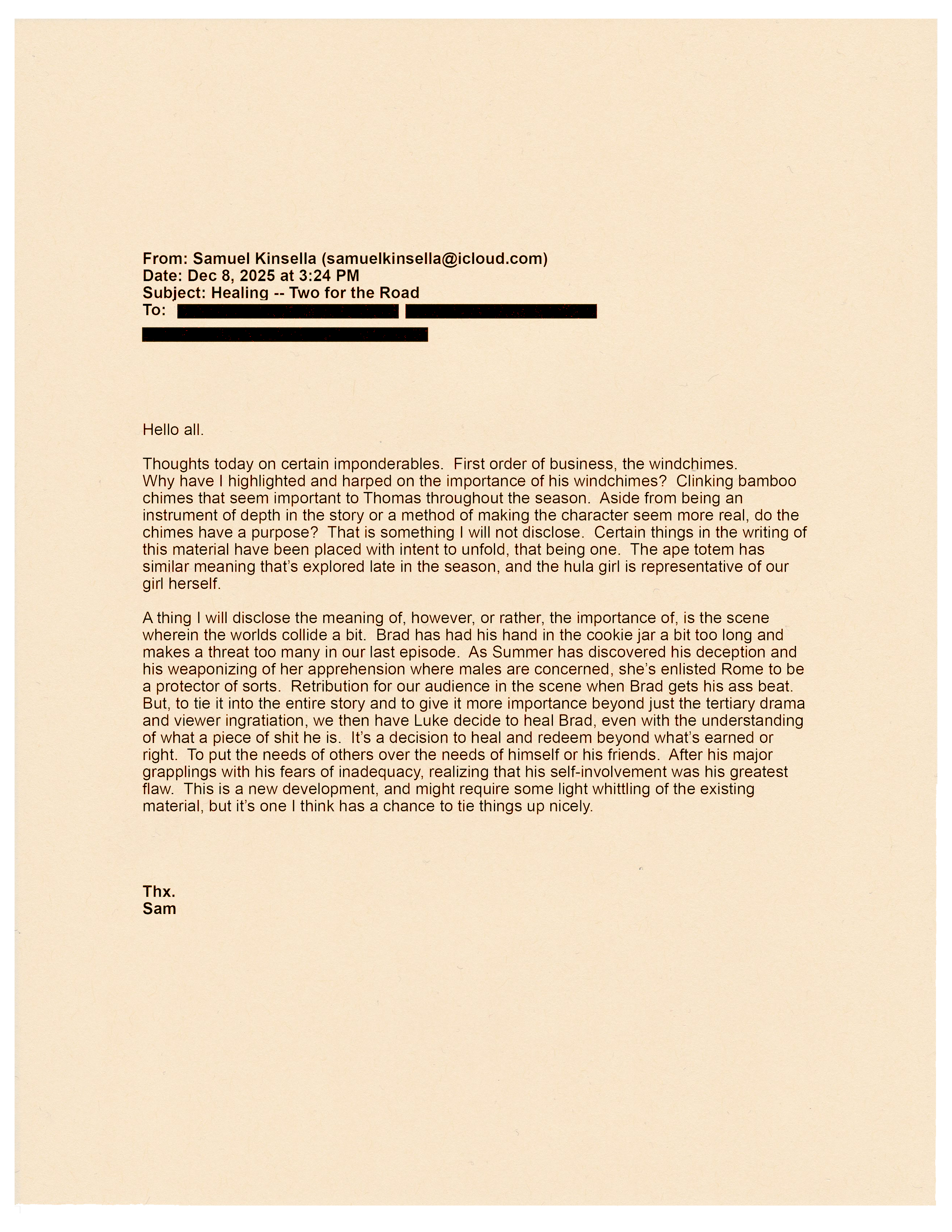
Look on my works.
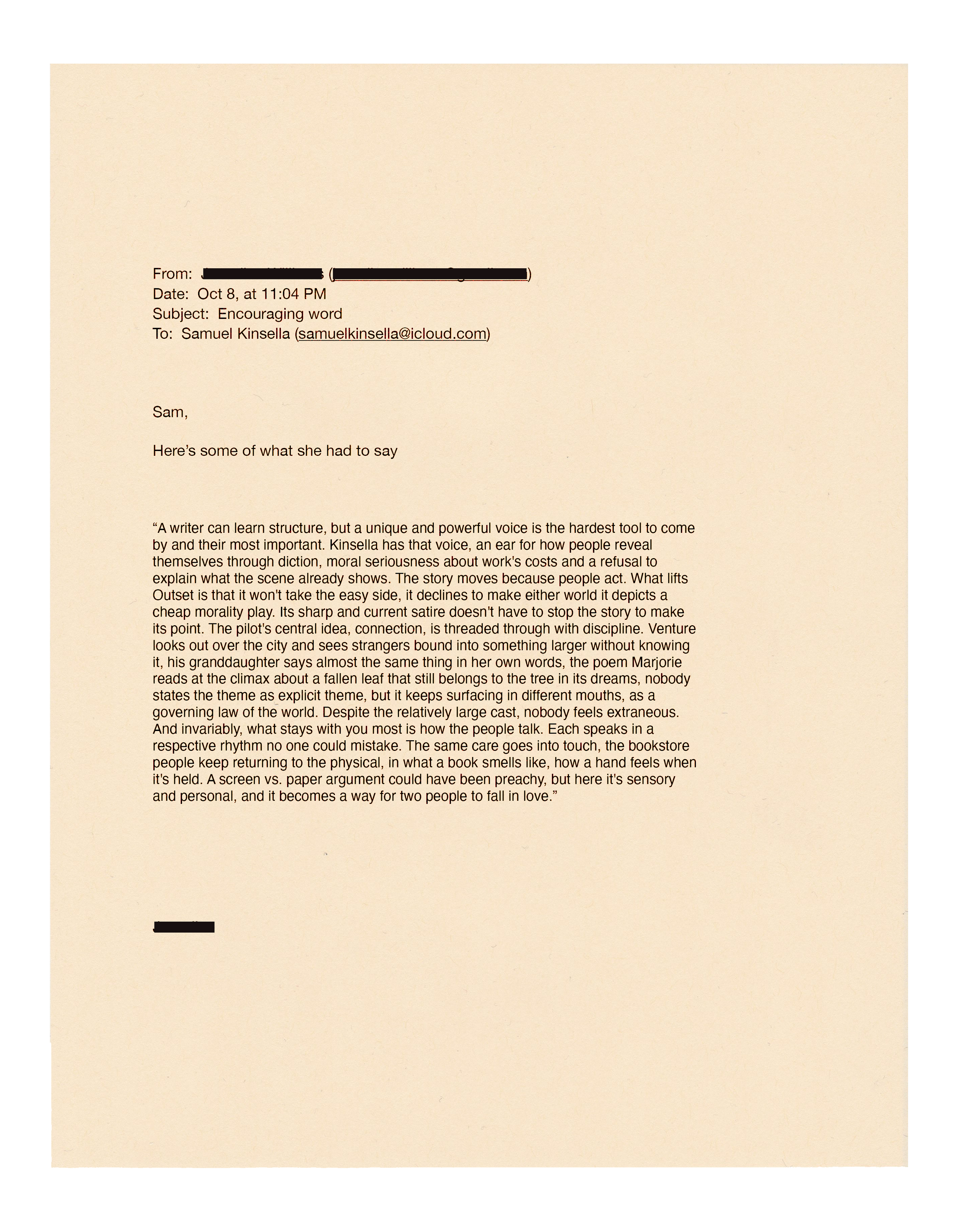
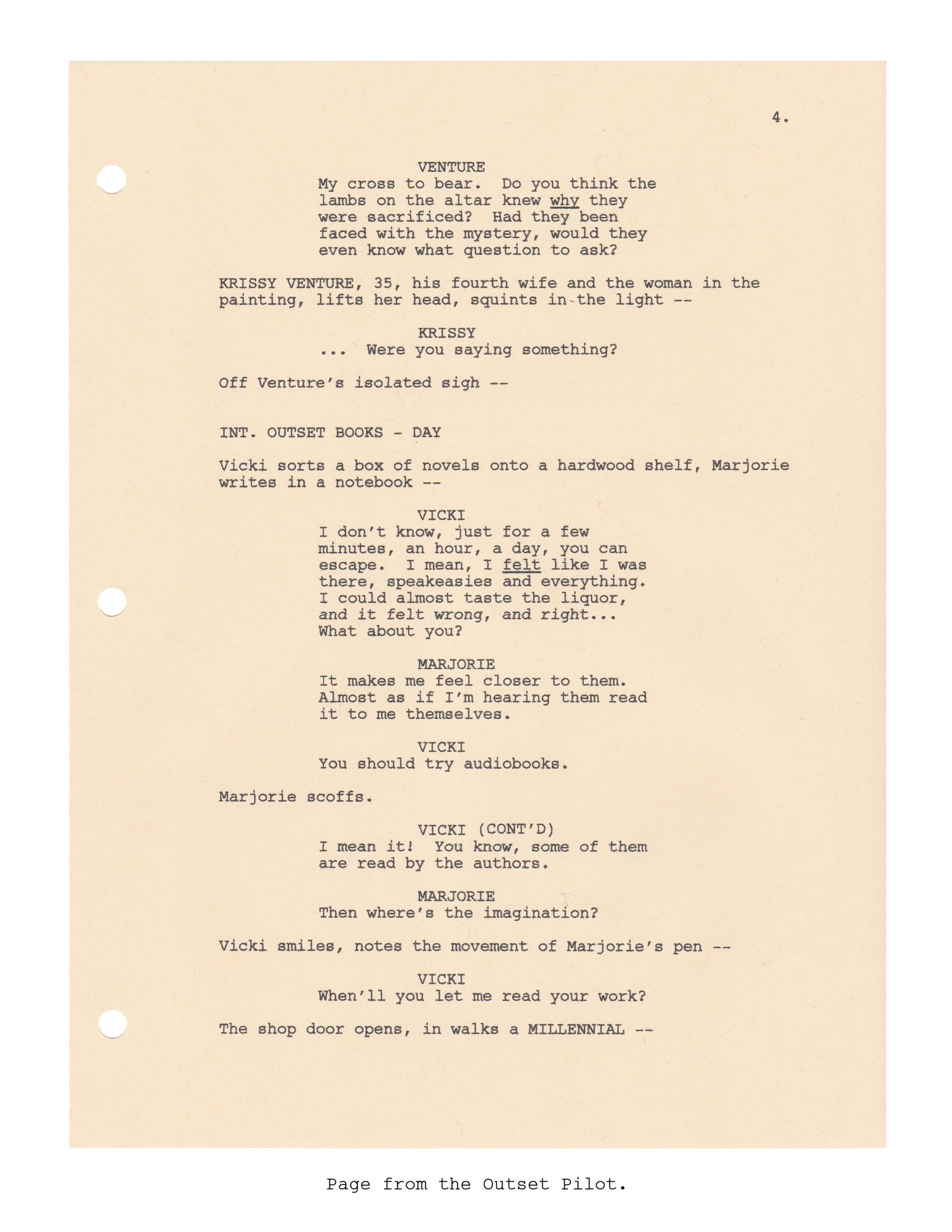

Short excerpt from the writing materials of Outset, September 24th, 2026.
An important thing to keep in mind for this series is every conflict for Outset would be a herculean task that, when seen from Venture’s distorted lens, would be like watching an ant struggle with a bread crumb. So when they spend a whole episode scraping together money to get a coffee machine to offer their patrons free coffee, the Venture corporate staff would be throwing away some five-thousand dollar coffee machine because they’re bored of it. And for Outset, if every task is such a struggle, it’s that much more rewarding when they finally win. That’s an element of story that needs less attention called to it, because just in the depiction itself, the contrast will illustrate the point.
The Outset aspect of this story is a modern found-family in decline. The independent shop slowly strangled by corporate gentrification, which some argue has negatives and positives, but Outset certainly perceives it as a negative. It’s a bit like how you could say, “You know, the meat industry’s actually something that feeds a lot of people.” And a cow might say, “You know, not for nothing, I’m not the biggest fan of the whole thing.” It’s the last of something trying to survive. The other side of this series is, on its surface, the fall of an empire. Both halves branch into representative depictions of all independent human endeavors against the gnashing teeth of the engine of commerce. But when you examine all the facets of the story, you come to understand that the people in the skyscraper are just as interesting as those beneath the skyscraper, and vice versa.
This is a series that will value recontextualization as a facet of the storytelling. Something that seems disconnected or unclear will come clear by the end of the episode or the subsequent offering. We need not necessarily put explicit viewer lucidity above all other elements of the piece, i.e. second-screen writing. Our primary concern is character coherence, illustrating in great detail their maturation, growth and change. Though, an element of the show which aids the experience of the viewer and ensures their idea of what’s going on is the fundamental juxtaposition. It’s no accident that the tone, visuals and content of the two halves of the show are very distinct. Outset is warm, cozy, dimly lit, inviting, and thoroughly charming. Venture might as well be a book grocery store. It’s cold, there’s no seating, rigid in its appearance and comportment. And on each “sales floor”, though Outset is only a sales floor, there’s a juxtaposition between the way the characters interact. Venture’s corporate and transactional, whereas Outset provides personalized recommendations from people who know and love books. This lends itself to an immediately identifiable cast of characters who, at all times, are shifting their values and deciding who they want to be.
There’s a titanic avarice rampant in some of these character’s ambitions that we watch deteriorate in private. Something that informs many of the movements and interactions of these characters that I’d hope would make itself apparent to the viewer is that even these people who seem to be on top of the world, much of the time, they don’t know what the fuck they’re doing. There’s an identifiable humanity in that. In these figures who are undeniably out of touch with reality, the reality the viewer lives in, what gives the viewer a window into their character is a series of moments where the character displays that lostness. They might identify associable confusion with their situation, or the character may admit they feel disillusioned. They calm a screaming child, they care for a dying parent, they break down in private, they drink to invite the erasure of pain, they read comments made about them and become hurt by them, whatever it is, it all gives us the sense they might, in fact, be people.
There’s a risk I’d take there, which is, I know generally very little about the specifics of what goes on in the business side of those figures’ lives. I’d struggle with the mechanical dialogue that a viewer would come to expect from a show that declares itself to be about business. Luckily, my intention here is to say this is a character show that happens to involve two businesses. That was always the intention. A Bezos type character, to my mind, is someone who lets the machine of commerce churn while they sit in the hot tub cupping their secretary’s tit. That’s where their story is. I think that kind of person “works hard” by getting other people to work hard for them. Abstracted, it’s a form of slave ownership. And that’s what I’d want to focus on here, not their rise into how they built the business, because that’s boring. I want to see that guy cheat on his wife and lose everything that makes him a real person, then show his despair in pretending to be relatable when he thinks eggs are a hundred dollars at the supermarket and thinks the average person would think that’s cheap. We’ve angled Venture differently than that, but that’s the aim rather than “Forbes article, here’s how Bezos became Bezos”.
That same untouchable figure can be humanized in the eye of the viewer if we examine them going through something humiliating or fundamentally damaging. On some level, every successful figure, every titan of every industry, they’re still fundamentally a child. Impulses and drives from early memory manifest every day for them. A Bezos figure might have been told he couldn’t do something as a child, so his entire life has been an effort to do that thing, to disprove whoever told him he couldn’t do it. Another small element of that characterization is understanding that some may excuse certain eventualities that rub against the grain of convention in order to continue doing what they’re doing. This can work on the small level of someone justifying their drinking, or it can work on that much larger level, “Well, listen, sure, my Chinese children factory workers need suicide nets outside their window, but I made three billion more this month, so I don’t know about you, but I see it as a win!” But, if you’re going to display that, especially on such a large and dangerous scare, then there’s also a survival undercurrent that should be present in that same character.
At some level, beyond the fictions we lay for ourselves and for others, beyond the lives we build up, the images and visages we choose to assume, we’re still a series of genetic patterns and electric impulses. Bezos, or whatever other prominent figure you want to think of in place of him, can be reduced to a series of natural impulses. If you put Bezos in a room for two days, he’d want food, he’d want water, he’d want to fuck something. If you put Bezos in front of a bear, on some level, his natural fearful survival impulses are gonna kick in. And that bear doesn’t give a fuck if he founded Amazon. To the bear, Bezos is a twinkie.
So this series is partially about the fall of an empire. That’s to suggest it’s the fall of a modern American enterprise, played like the empires of the past. This entails the possibility of pulling from the empires of history, the empires of Shakespeare, and the empires of biblical anecdote. There are many levels of abstractions. We can pull from all of it. When Nero died, he said “What an artist dies in me.” That’s a beautiful spasm of self-involvement, but it was also true. He was a performer, stabbed himself in the neck. He played his lyre while the empire at his fingertips dwindled and burned. That kind of idea is one I’d want to employ for this series, that even though Nero was a leader of this mighty empire, at his most bare, he saw himself as more of a poet and musician. There’s more depth than what things seem to be.
[…] A big thing to keep in mind is that the public’s apprehensions toward that kind of figure, i.e. the billionaire, are so momentous right now, I think they’d not want to allow their thoughts and methods of thought to be challenged. The risk is having a viewer see this as a series about billionaires. If they see that, they’re gonna say fuck this show, I’m boycotting it. And it’s not a show about billionaires, but at that point it won’t matter, because someone who hate-watches something is convinced from moment one that they’re gonna hate it, and so they won’t even allow it to change their mind or surprise them. So we’re not aiming to tip the hand so quick with him, he needs to be a figure shrouded in darkness. One thing in his character that will buy some interest from the viewer is that he’s already at the point where he hates himself and what he’s built. He’s ashamed to admit how much money has passed into his hands. But it’s not for the reasons we might think. It’s not the easy solution. […]
Short excerpt from the writing materials of Outset, September 24th, 2026.
The script is not a fucking blueprint. That’s a hill I’ll die on. The script carries all the meaning of the piece. So understanding that, you realize it’s important to get it right. In order to get it right, you have to true to the movements and sensibilities of the characters.
It’s difficult for me to outline. I once tried making a beat board, it perplexed me and subsequently pissed me off. I didn’t know why I would write those things in another place just to go write them in the script five minutes later. I don’t believe in writing on index cards. I just sit in front of Final Draft, write a loose suggestive idea of how the story should go, then I start writing the scenes. You have to know that your outline must submit to the eventual actualities of the piece. That’s not to suggest these episodes shouldn’t be structured or there’ll be no plan going into the episode, but to so stringently follow an outline or a structure is to do a disservice to the story. But, maybe something to do for each scene is to make an index card off what changed because of the scene. That might be a good exercise to make sure something’s always happening. In that definition, I tend to not be so reductive. If we’re deepening the viewer’s connection to the characters and widening their understanding, that’s something happening. Not every “thing happening” is a high speed car chase.
In writing, whether you’re the piece’s originator or not, you should have an emotional connection to the work, but the work’s only merit can’t be your personal connection to it. It has to become something universally identifiable in order for it to be a viable article of commerce. The work must not rely on the facts of your own experience, but the feelings those facts generated. Present abstracted personal experience as specific character experience in order to elicit feeling on the part of the viewer.
More times than not, what I like to do is establish a little intrigue and mystery by starting your viewer in the dark. Then, hang a lantern on something, direct their attention, their eyes start to adjust, and eventually they’ll make their own light in the story. They’ll have a much deeper connection to it. But if you start out with the block of exposition and give them a clear plain english version of the story from jump, there’s nowhere left for them to be intrigued by the story. When everything is spelled out, you have nowhere to go, because the viewer has been disillusioned about the spiritual magic of the story. And if then, you spell out exactly what everything means, then there’s no room for the viewer to interpret the events of the story and attribute their own meanings to things. If you spell everything out, your story will be much less engaging. Suggest things, light a match, and with your secret guidance, let the viewer think they found their way in the dark. You have to appeal to the viewer’s sense of themselves and their capacity to relate. Ingratiate that. And if the viewer is any kind of conscious, they’ll reject predictable linear storytelling and favor an in depth examination of the emotions and personalities of fully accomplished and developed characters that they can see pieces of themselves in.
Especially near the beginning of a piece, I don’t hurry to explain all of a character’s backstory beyond sympathetic hint at the past. The reason for that is we’re already sympathizing with his present situation, which is the circumstance we’ve witnessed firsthand. If he’s likable and affected by the events in the pilot, we don’t need to know his backstory yet. That takes a backseat to present events. We can infer off their behavior and their experiences that there’s something else going on, and even if we don’t yet have all the information, we’ll get there. It’s trusting the characters and the writer. All this in mind, in a sense, we’re telling the viewer, “In watching this, not only are you gonna get an escape from all the bullshit in your life, you’re gonna grow without havin to do any of the work. You’re gonna witness someone you’ve grown to love come to those realizations for you, achieve the fantasies you want to indulge, attain the success you want, whatever it is. Wanna watch these characters you love go through these things? Boy, have I got a show for you.”